Happy July 4th 🎆 and happy 250th birthday, America!
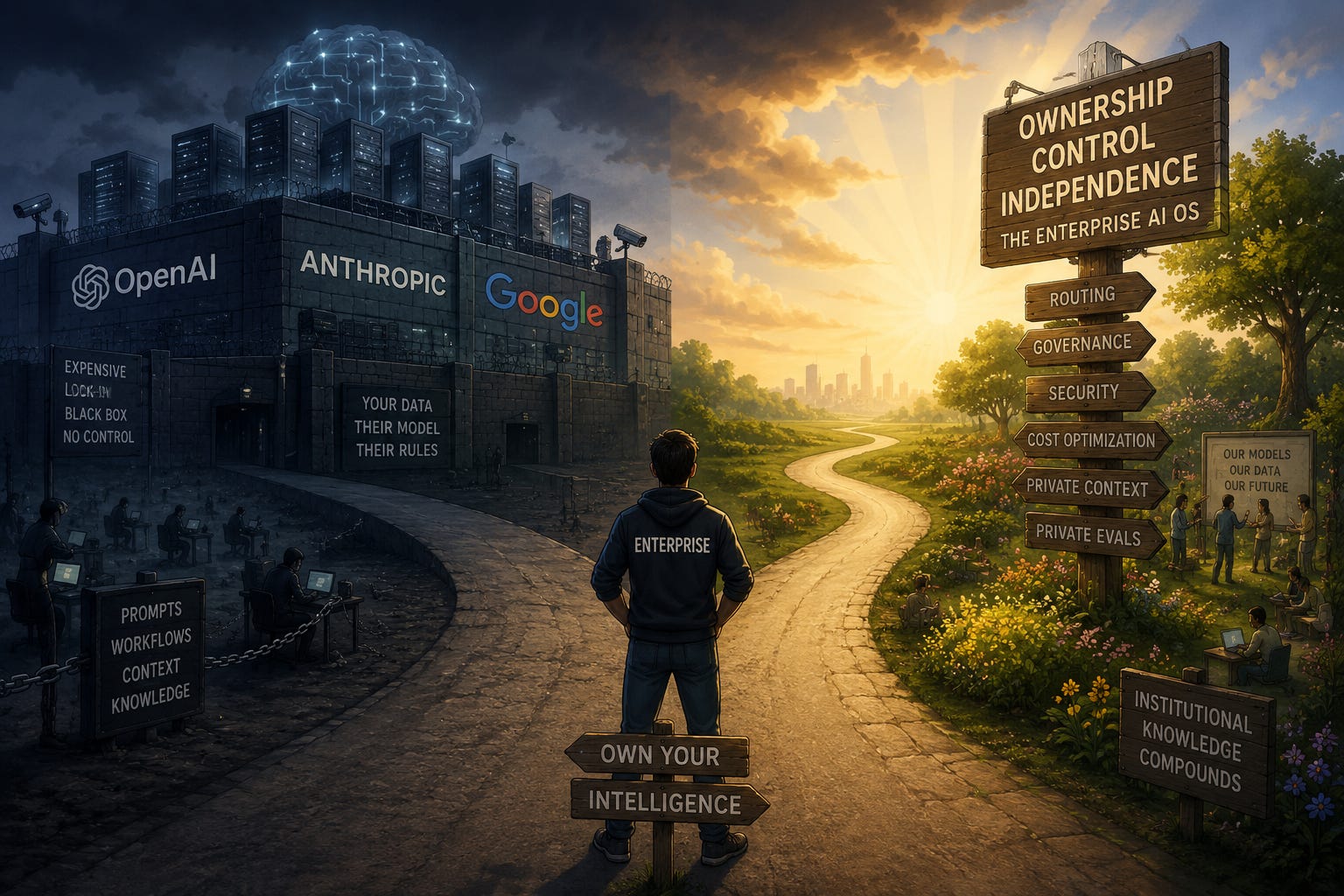
This weekend is all about celebrating independence with family and friends. It also feels like the perfect backdrop for one of the biggest debates emerging in enterprise AI: who actually owns the intelligence being created inside a company?
That is why Alex Karp’s latest rant couldn’t have come at a better time. He put his finger on one of the defining questions in enterprise AI.
Palantir CEO Alex Karp on what customers actually want, the real business of frontier labs, and the importance of open source models:
“What the technical customers want is control over their compute, their models, their data stack, and their alpha. They want to know they own the means of production, and it's not being transferred to someone else.”
"Who owns the data? Are the prompts secure? Is this being transferred to you?"
"If it was so valuable, and I can make you a billion dollars, wouldn't I say I'll make you a billion dollars and I want 30%? Why are they charging for tokens if it's so valuable?"
This conversation is only accelerating as the technology providers who don’t have their own dog 🐶 in the model hunt, are leaning on their advantage which is, “come work with us, we will just make AI work for you and you will own it.”
That is a very powerful message right now.
The FDE that Palantir invented and that we all know about, the forward deployed engineer, is at risk of being something much much different which I higlighted a few weeks ago.
Because the more the model builders like OpenAI, Anthropic, Google and others push FDE-style services into the enterprise, the more every CIO and CEO has to ask a very simple question: are they helping me build my own AI capability, or are they extracting my workflows, data, context, and institutional knowledge?
In other words, are these Forward Deployed Engineers?
The question isn’t whether enterprises should use OpenAI, Anthropic, Google, or any other frontier model. Of course they should. The real question is who owns the learning loop. Who owns the prompts, the context, the workflows, the evaluations, and ultimately the institutional knowledge created over years? That’s where the real enterprise value compounds. This is also where startups have an incredible opportunity. That last mile is incredibly messy, and enterprises are looking for help owning it.
That’s why I don’t think the frontier labs are going anywhere. They have amazing technology and will continue to power countless enterprise workflows. But enterprises need to be very clear-eyed about what they’re renting, what they’re building, and, most importantly, what they actually own.
This is what I wrote about last week and the week before.
The first era of AI was about building intelligence. The second era of AI isn’t about building smarter models; it’s about controlling intelligence through routing, governance, security, cost optimization, private context, and private evals.
That control layer is becoming the operating system of enterprise AI.
The path from here feels pretty clear: independence and control will matter more and more, especially as it gets easier to post-train open weight models. Sovereign AI won’t just matter for countries, but also for every enterprise…and eventually every single person 👀 - yes I have something coming out soon 😄.
For those startup founders in the software infrastructure space who feel pretty beaten up at the moment since every VC on the planet says the frontier labs will own your business, this is the best thing that could have happened to you - the enterprise AI wake up call and your time is now and accelerating. Stay the course!
It’s also interesting to see Yann LeCun making a similar argument:
Infrastructure wants to be open. Foundation models are becoming an infrastructure and will inevitably become commoditized. Long term, the money is in the application layer, which is what I, Arthur Mensch, Alex Karp, and others have been saying.
#yes own your AI and fine tune - this is so important to understand, esp based on the rant above:
Frontier models we tested on struggle with relatively simple financial tasks, and model advances don’t improve performance much. In contrast, we’ve shown that high-quality proprietary datasets labeled by expert investors and used for fine-tuning produce custom models that exceed frontier performance on our tasks. We have found that this outcome holds true well beyond the six tasks we’ve discussed in this post.
#we at boldstart love robots 🤖 and have made our 3rd investment in the space with Generalist AI being our first at inception 2 1/2 years ago but…this worries me - lots of money piling in…
#table stakes for cybersecurity cos 👇🏼 - full story from our day together at the JPM Cybersecurity summit a few months ago - venture investing in cybersecurity was $11.5B in 2025, the highest since 2022!
#when the government control access to SOTA models?
#the bear case for frontier labs - interesting to hear the extreme negative perspective as well - don’t fully agree with lots but interesting to watch nonetheless