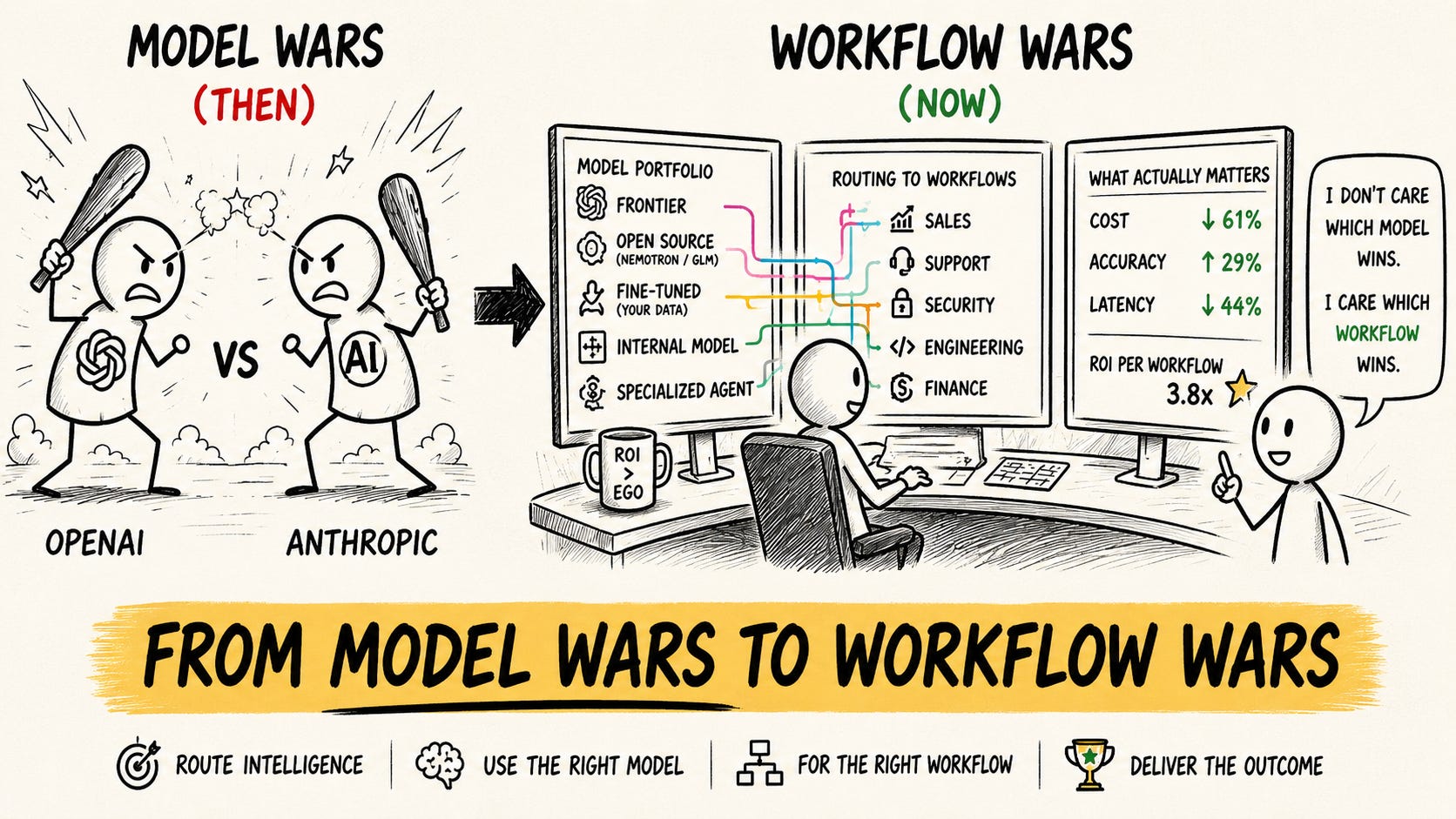
Your employees, your business processes, your workflows, your data…so why not your AI?
Until now, building AI around your enterprise has been difficult, time consuming, and expensive. The tradeoff was simple: use frontier intelligence and pay for it, or use cheaper models and sacrifice capability.
That tradeoff is starting to break.
The messaging this week was coming from all directions, but it pointed to the same idea: enterprises no longer have to choose between intelligence and economics.
Some are building AI around their own data, workflows, and institutional knowledge. Others are going further, combining proprietary data with open models, post-training, and routing. Different approaches, same destination: more control, better economics, and AI that increasingly reflects the business itself.
A week ago this felt like a pitch. This week it started looking like a roadmap, although we’re still early.
As discussed in last week’s issue #500, the budget pressure is real and it’s forcing the conversation. Listen to Dara at Uber:
Dara (CEO of Uber) on their AI spend:
"We blew through our AI budget in a quarter, for the whole year. It is forcing us to adjust.
We are going to meter headcount increases because to the extent that my engineers are getting much more efficient, their throughput is https://t.co/V1tuIxaFoa
8:43 AM · Jun 4, 2026 · 5.19K Views
3 Replies · 5 Reposts · 21 Likes
Let's look at three vendors to dig in further. First, Palantir. It costs you money, but it’s smarter because it understands your data, workflows, and institutional knowledge while keeping them under your control. Alex Karp lays it out:
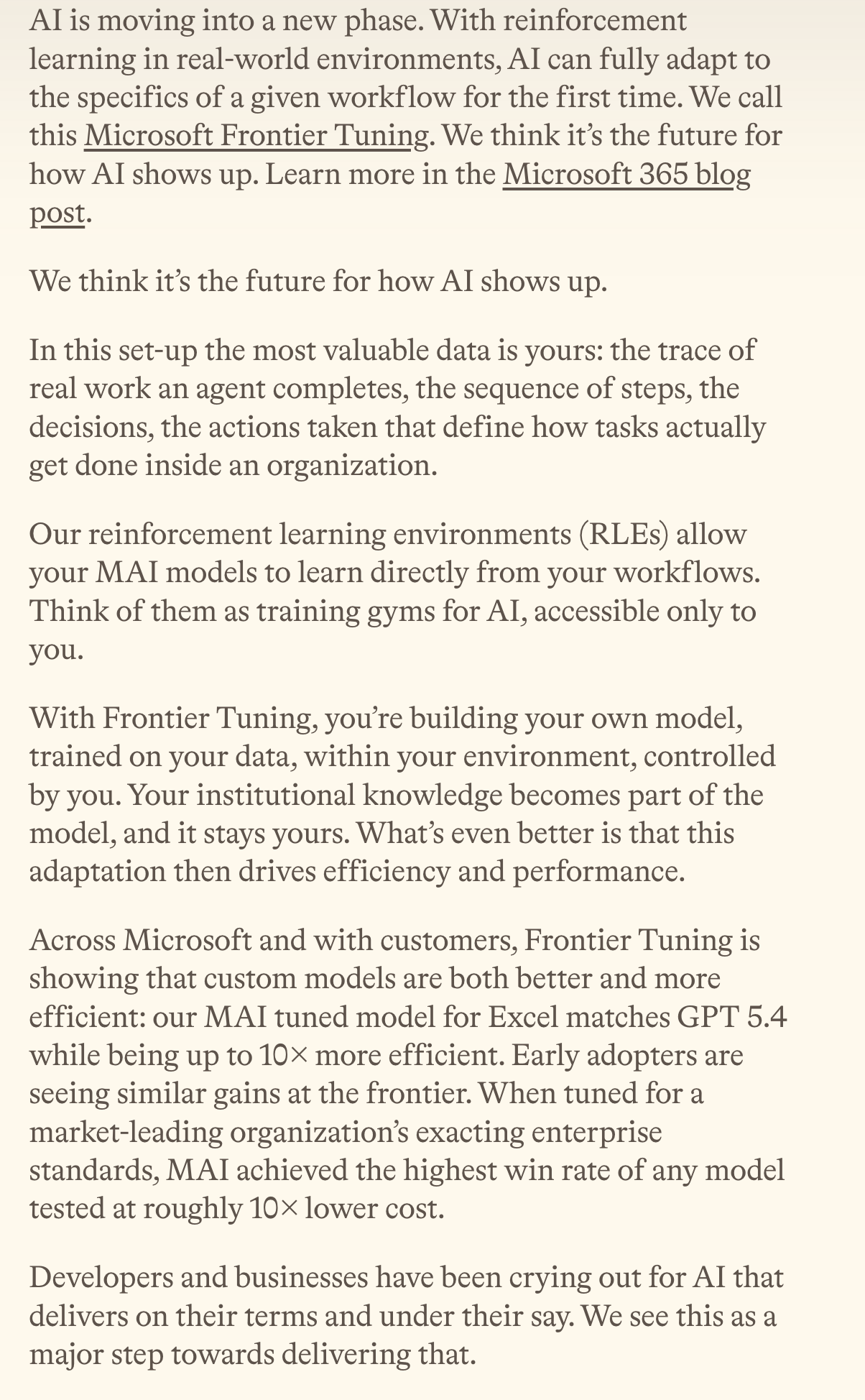
The frontier labs heard it too. Microsoft's answer is to make the model yours. They launched 7 new models, yes they're in the race with OpenAI, Anthropic, and Google, but more importantly read this from Mustafa's post:
With Frontier Tuning, you’re building your own model, trained on your your own data, within your environment, controlled by you. Ok, this is not open source and neither is Palantir but you do get my point - why use a frontier lab model at the highest cost when perhaps i can rearchitect a better way. Microsoft claims that Land-O-Lakes has a 10x more cost efficient model than Open AI’s GPT 5.5.
Here’s the fork worth naming out loud.
“Own your AI” is splitting into two camps.
Context is yours: Palantir and others are helping enterprises build AI around their institutional knowledge, workflows, permissions, and data. The model underneath can change, but the enterprise context becomes the asset.
Model is yours: Nemotron, GLM, and the post-training crowd give you the model, the data, and the weights, with routing on top.
Both beat renting raw frontier intelligence for everything.
Frontier models aren’t going away. But long term I’m betting the biggest winners will combine frontier intelligence with proprietary data, enterprise context, workflow orchestration, and increasingly their own models.
Control compounds.
The company that owns the AI behind its critical enterprise workflows has more control over its economics, its roadmap, and ultimately its competitive advantage.
That’s not a hedge. That’s the call.
Which is why I love Nvidia putting significant dollars behind Nemotron, which is catching up fast and was released under a new MDW open license: open model, open data, and open weights.
We will move to a world like Clem says where post-training with more control of your data and evals will become an important way to build agents. This is also a world we invested behind at boldstart a couple of years ago with Uare.ai. Here’s an excerpt from founder and CEO Rob Locascio talking more about what and why (stay tuned for release soon!)
Everything above is the same argument told in bits. Generalist AI is that argument told in atoms.
Your data, your model, your AI. The catch in the physical world is that there is no Reddit for robotics data. You can’t scrape your way to a foundation model when the foundation doesn’t exist. So the moat isn’t the model, it’s how you manufacture the data no one else has.
Generalist went and built it. 3d printed data hands on real human hands, video of every kind of work getting done, over 500,000 hours of proprietary training data feeding their own model. With GEN-1, deployments are live and the model learns new skills in hours to days. Same playbook as the software camp, just in robots: own the data, own the model, own the outcome.
Which is why I'm 🔥 up that the company announced its most recent round, $400M at a $2B valuation. New lead Radical alongside 8VC, Union Square, Hanabi, Norwest and more, with existing investors Nvidia, boldstart, Spark, Jeff Bezos and more. Angels include Eric Yuan, Bin Lin, Fei-Fei Li, and Naval Ravikant.
We led the inception round in March 2024 with Nvidia because we believed the autonomous enterprise doesn’t stop at software. It extends into the physical world, where the real value of labor lives. GEN-1 is the proof. If you want the founding story, read my partner Ellen Chisa’s post on Pete Florence, Andy Zeng, and Andy Barry, the PhDs, DeepMind, and the lifelong passion behind it.
And as Masa says, the opportunity is simply massive
The tradeoff is starting to disappear. Frontier or affordable, owned or rented, smart or cheap. Those were yesterday’s either/ors. This week made them ands.
The question is no longer whether you can own your AI. It’s whether you can afford not to.
The future isn’t frontier versus open. It’s who owns the context, who owns the model, and ultimately who owns the outcome.
As always, 🙏🏼 for reading and please share with your friends and colleagues
Thanks for reading What's Hot 🔥 in Enterprise IT/VC! This post is public so feel free to share it.
#🤯 will AI build itself? Anthropic sees a path to recursive self-improvement - read the data - engineers ship 8× more code/quarter, 80% of codebase is AI-written, coding success at 76%, 52× training speedups, and beats humans 64% on research decisions. This closes the loop for AI to autonomously design better successors. Massive upside…kind of insane!
#💯 which is why companies need intelligent process mining and mapping to understand workflows in order to figure out how the org works and how to improve
#and also why many cos are using Forward Deployed Engineers (FDEs) to kick off the process as well and more importantly measure what success is - read the full post here
#super cool video and post from Guy Podjarny of Tessl on the Emerging Agentic Stack and why “context and skills are the new code.” Software development is transforming from writing code and implementation to defining intent and instructions. Code is becoming “disposable” and easily regenerated, while context (guiding the AI agent) is becoming the primary unit of work.
along with a deeper discussion with friend James Kaplan, CTO McKinsey, on the future of software development with Guy from Tessl (watch here)
#more of the same but for security harness engineering