The world is moving so fast that sometimes when you take a step back and look in the rearview mirror, it’s hard to comprehend the moment we are now experiencing.
2 numbers got my attention this week.
First, AWS and the hyperscalers delivered. We thought the cloud was the biggest technological shift that ever happened. AI dwarfs it.
AWS hit a $58M annual revenue run rate 3 years after launch. AWS AI revenue is over $15B at the same point, nearly 260 times larger 🤯.
Reportedly $44B ARR, up 46.6% in a single month. No surprise they are raising at $900B just months after closing at $380B.
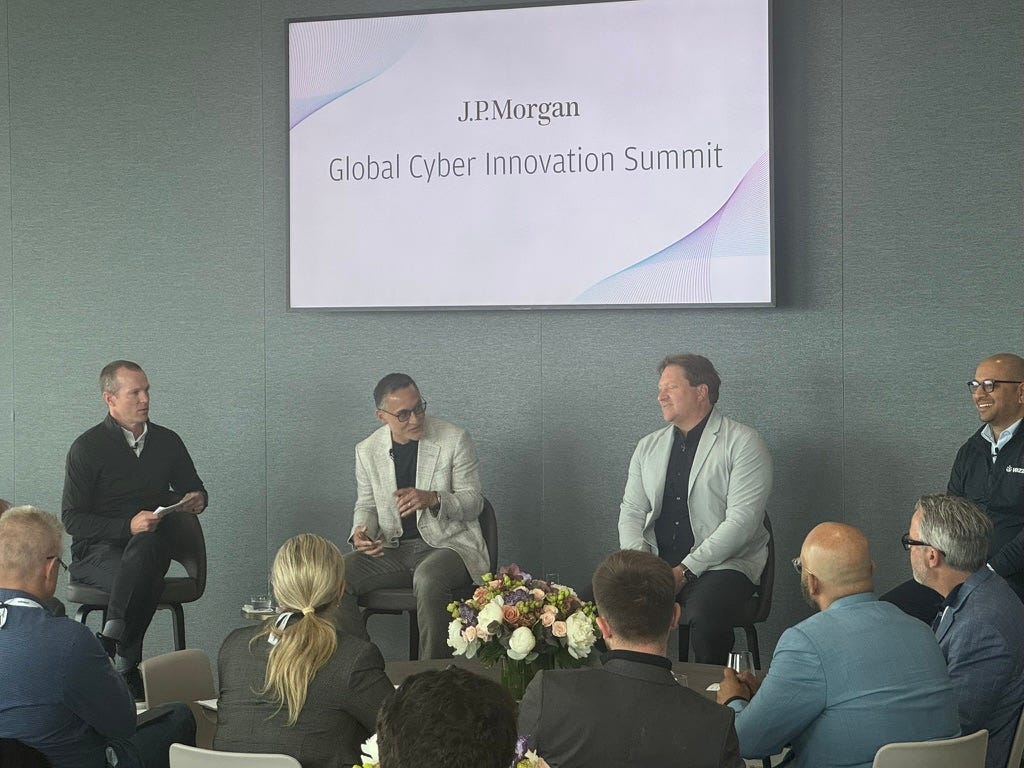
So the real question, and the one I got speaking at both the J.P. Morgan Cyber Innovation Summit and Slow Security Summit this week, is this: when the hyperscalers and frontier labs seem to be swallowing every opportunity, how do you invest at inception?
My short answer: incredible technical talent with an opinionated 12-18 month product view, and a mission that can endure for 5-10 years. None of us know exactly what will be right, but the best talent pointed in the right direction will make the right adjustments at the right time.
That is why learning velocity matters. I want a founder who can articulate a clear starting anchor, hold strong opinions loosely, and adapt fast. They don’t chase the flavor of the week, but they also know what worked last month may need to be scrapped.
Fundamentally, we are living in a world with two constraints, neither of which is capital for founders with incredible ideas: compute and talent.
To that end, before we invest at inception, we want founders to show us who their 5-10 key hires are going to be. We love when founders have world-class engineering talent ready to go the moment the investment closes so they can hit the ground running.
Many of those early employees will usually have a history of working for or with the founder. That matters. It tells us the founder can be a Pied Piper for the very best.
And when it comes to cybersecurity in particular, there are two ways to make money.
One is to go after new attack vectors well before they are mainstream. Protect AI is a great example. We were there from the very beginning, a year before ChatGPT was even released.
The other is to reimagine existing solutions and do it 10x better than what already exists. On the first, you are susceptible to market timing and experimental budgets. On the latter, you are facing incredible incumbent competition.
Irrespective of your approach, while we all strive for a massive IPO, most exits in cybersecurity are through acquisition, and many times they are sizable before any real revenue is realized.
What that means, once again, is that acquirers are buying talent. The very best builders and engineers aren’t joining large public companies. They are starting their own companies.
So there are really two lanes from here, as I wrote in What’s 🔥 #492.
You can invest in deeper technical companies like robotics, where the difficulty is durable and physical. Or you can invest in the AI jet stream, where most software companies now live with both excitement and fear about what the frontier labs may ship next.
I also went deeper on the jet stream framework, inception investing, and my broader 5Ps framework with GTMNow last month.
At the end of the day, this is still about people.
People have taste. People learn fast. People recruit other exceptional people.
Models change. Product surfaces shift. The frontier labs will keep shipping. But the founders who win are the ones with the taste to see where the world is going, the learning velocity to adjust when the world changes, and the magnetism to bring the best builders with them.
Both lanes can work. But in either lane, the bar is the same: technical taste, learning velocity, and the ability to recruit world-class talent before the opportunity is obvious.
As always, 🙏🏼 for reading and please share with your friends and colleagues!
Thanks for reading What's Hot 🔥 in Enterprise IT/VC! This post is public so feel free to share it.
#We have a clear marketing problem in the tech industry and great to see leaders calling it out. Doomerism and mass unemployment are not going to help any of us moving forward.
#We are still feeling the hangover from so many companies over hiring during ZIRP, blaming it on AI is what the markets are reacting positively too but the reality is that AI and agents are still barely deployed in production at many of the largest enterprises. I strongly believe we will have more short term pain in terms of job loss but in the long run, AI will help create more jobs as companies grow faster with less.
#I often write about the last mile in the enterprise is the longest meaning the preparation needed for enterprises to deliver secure, private agent ready infrastructure at scale requires a lot of work and consultant to help even build the agentic workflows - Aaron Levie goes one step further as these workflows are in production, what happens next?
#distribution versus product - will be interesting to see how this impacts Harvey, Legora and others
but Tae Kim who wrote the Nvidia way, nails is here - what does this look like moving forward as OpenAI is building momentum while folks complain about Anthropic