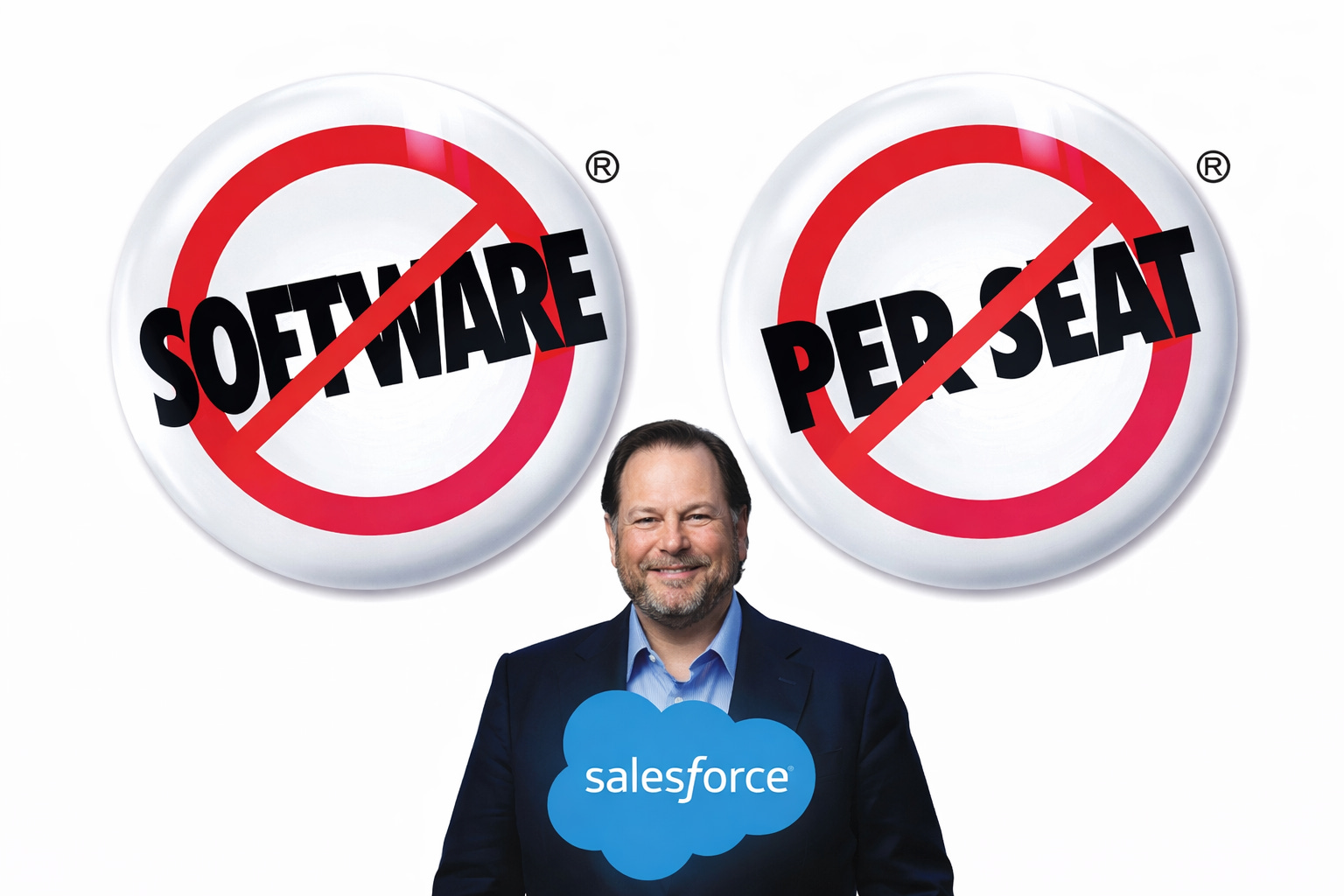
From No Software to No Per-Seat: Benioff Takes a Sledgehammer to His Own Creation
Apr 18, 2026
The SaaSpocalypse debate rages on. Seat-based pricing dying. SaaS reduced to systems of record. Entire products vibe-coded away. Where I’ve landed: the core SORs with complex rule engines and embedded workflows - Salesforce, Workday, ServiceNow - are so deeply embedded that most large enterprise buyers will simply use the threat of “we’ll build some of it ourselves” to negotiate lower pricing. The real question for these incumbents isn’t survival. It’s where the next revenue lever comes from.
Enter Marc Benioff. He just ripped the band-aid off.
Let’s pause and appreciate what’s happening here. Twenty-seven years ago, Benioff built Salesforce on a radical idea: kill software, move everything to the cloud, charge per seat. The “No Software” logo became iconic. He didn’t just build a company, he built the SaaS business model that an entire industry runs on. Now he’s taking a sledgehammer to his own creation. The same guy who killed on-premise software is now killing per-seat SaaS. That takes huge kahunas. And the recognition that if he doesn't do it to himself, someone else will.
Salesforce is going headless. It’s called Headless 360, and it exposes every capability in the platform as an API, MCP tool, or CLI command. 100+ new tools, day one. Claude Code, Cursor, Codex can now operate an entire Salesforce org without opening a browser.
I wrote about this exact scenario back in What’s Hot #410 (Sept 2024) - that Benioff’s push into agents could put Salesforce at existential risk because once the front-end gets reimagined with AI, the application becomes just a database and customers migrate to cheaper, faster, more agile systems. I thought this was a 5-year arc. It took 18 months. Benioff isn’t fighting it. He’s embracing it. Instead of blocking access and protecting the UI moat, he’s betting that Salesforce becomes the platform agents talk to, not the screen humans click through. As Salesforce put it: “We made a decision two and a half years ago: Rebuild Salesforce for agents.”
In other words, he’s taking the pain now.
Seat counts are already dropping. Large enterprises are renegotiating. But by getting ahead of the transition, Salesforce may find a tailwind depending on how they price. More on that later.
This is the opening shot for system of record incumbents - expect others to follow soon after. The ones who resist are telling you their moat was the UI, not the data.
There’s a deeper technical story here that matters for every enterprise deploying agents. As Salesforce EVP Jayesh Govindarjan told VentureBeat, early Agentforce customers hit a wall: “They were afraid to make changes to these agents, because the whole system was brittle. You make one change and you don’t know whether it’s going to work 100% of the time.”
The core tension is that agents are probabilistic but enterprises demand deterministic outcomes. Most real-world workflows are a mix of both - steps that must follow strict business logic and steps where the AI should reason freely. Salesforce’s answer is Agent Script, an open-sourced DSL that defines a state machine in a single flat file - versionable, auditable - where enterprises specify exactly which steps are deterministic and which are probabilistic. This is the real battleground. The winning agent platforms won't be the ones with the best models. They'll be the ones that let enterprises blend determinism and flexibility in a way that's auditable and won't break on the next update.
Short-term revenue hit. Long-term growth story. Do the math. 100,000 human users at $300/seat is $30M. Replace those seats with 1,000,000 agents making API calls 24/7 and suddenly the ceiling isn’t headcount anymore. It’s volume. Humans work 8 hours a day, 5 days a week. Agents work all the time. Consumption-based pricing in an agent-led world could dwarf what per-seat ever delivered. If you get the model right.
In a world where agents outnumber humans 1000+ to 1, the pricing model determines everything. Per-seat is dead. Per-call, per-outcome, per-transaction. Whoever figures out the right model doesn’t just survive. They win. The SaaS business model is being rebuilt in real time. Let’s see who moves next.
As always, 🙏🏼 for reading and please share with your friends and colleagues!
Thanks for reading What's Hot 🔥 in Enterprise IT/VC! This post is public so feel free to share it.
Of our @Forbes AI 50 list...forbes.com/lists/ai50/
88% are US-based
64% are Bay Area-based
50% are San Francisco-based
14% are New York City-based
Conclusion...if you're building an AI company, build it in San Francisco
*I live in San Francisco so I'm biased
6:55 PM · Apr 16, 2026 · 5.4K Views
3 Replies · 7 Reposts · 32 Likes
#just love ❤️ sharing these stories of founder grit and resilience
#full AI budget blown in 3 months, sure SOTA matters but good enough and costs do as well - will be interesting to see how this plays out in the enterprise
#banging on the same 🥁 - AI is not killing cybersecurity. It is accelerating it. Frontier models are turning vulnerability discovery into a commodity. When discovery becomes cheap, remediation, governance, and automated defense become the new security market.
#great to see older school ZIRP era unicorns accelerate growth even faster with successful launch of AI products, Parker and Rippling sharing how it’s done
#this will be standard for many CEOs in months, not years…privacy, security, etc will be paramount to making this work properly and truly capturing Zuck or any CEO
“The Meta chief is personally involved in training and testing his animated AI, which could offer conversation and feedback to employees, according to one person. They added that the character was being trained on the billionaire’s mannerisms, tone and publicly available statements, as well as his own recent thinking on company strategies, so that employees might feel more connected to the founder through interactions with it.”
#AI blends into the physical world including bio - solid market map from Bessemer (we have two port cos already with one being Topos Bio and other in stealth)
#🍿 $2T in private credit, three major funds blocking redemptions in the same month, and the Fed quietly asking banks for their real numbers. This is how 2008 started - slowly, then all at once. And this time the debt is wired directly into the AI infrastructure buildout.